

Short Approaches (SHAPP) involve optimizing the flight path during the approach phase to minimize the distance traveled and the time spent at lower altitudes, where fuel consumption is higher. This technique is particularly beneficial at airports where long, circuitous approaches are the norm due to airspace constraints or noise abatement procedures.
It includes any operational technique that reduces the ground distance of the final approach segment. Instead of flying the full published lateral profile (STAR, downwind-base-final, or long visual final), the aircraft turns earlier or shortens the pattern in a controlled manner.
Short approaches are not a single procedure but a family of pilot or ATC-initiated techniques.
What you'll learn: |
1. Operational techniques
A short approach may result from ATC instruction, pilot request, or published procedures. Here are the main techniques used nowadays.
Most short approaches are flown visually. Event if visual approach is not automatically shorter, it is the best moment to issue a short approach.
It can be initiated by the controller or requested by the pilot.
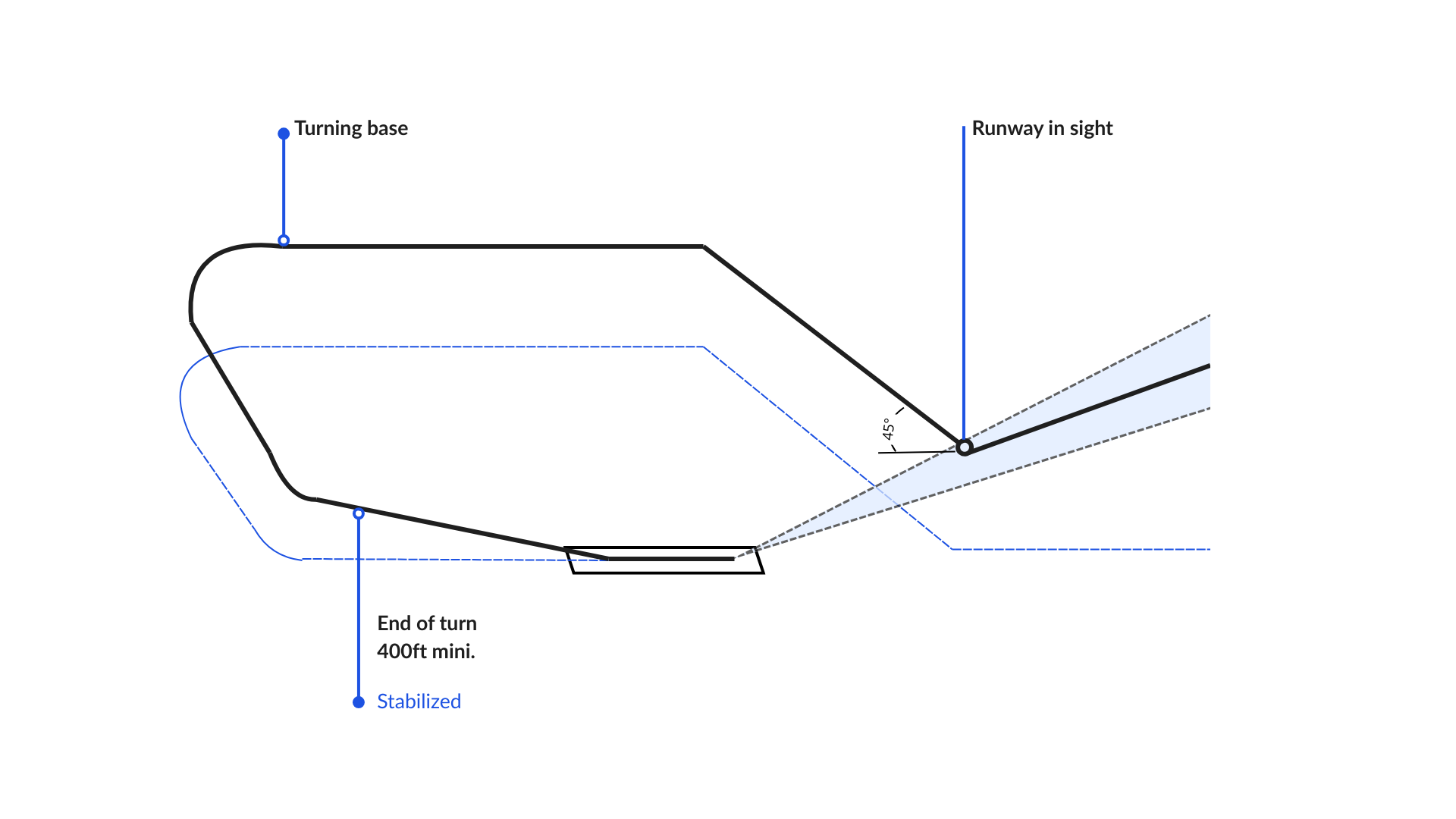
In practice, the aircraft no longer flies the full downwind–base–final rectangle. Instead, the turn to base or final starts earlier, and the intercept to the runway occurs closer to the threshold.
The pilot then manages the aircraft energy very actively as:
- A shorter pattern leaves less time to decelerate and configure. Crews often select gear earlier than usual and use intermediate flaps already in the turn.
- Thrust changes are frequent, because the aircraft can lose speed quickly in a tight base-to-final.
- The goal is to roll out on final aligned with the runway, on the correct vertical path, at the planned approach speed, and with all checklists completed.
- The stabilization gate (for example 1000 ft in IMC, 500 ft in VMC) remains non-negotiable.
-3.png?width=340&height=209&name=image%20(9)-3.png)
When conditions are right and the maneuver is anticipated, the visual short approach is one of the simplest ways to reduce ground distance. It limits vectoring, cuts level segments, and gives the crew direct control over a compact, efficient energy profile.
RNP-AR Approaches are a more advanced navigation procedure that allows for highly accurate flight paths, even in challenging terrain or congested airspace.
Based on the principles of Performance Based Navigation (PBN), RNP-AR enables crews to fly approaches using internal navigation tools, allowing for the design of more precise trajectories.
.png?width=1920&height=1080&name=RNP%20AR%20%20%20(1).png)
Benefits:
- RNP-AR can reduce the distance & time flown during approach and landing. The direct impact on fuel consumption reducing it up to -14% compared to traditional approaches. (Source: O. Sahi, E Turgut, S. Aslaner and O. Usanmaz (2019) Fuel and Carbon Dioxide Emission Assesment for a Curved Approach Procedure)
- It improves the vertical profile, avoiding unnecessary level-off at low altitudes, where the fuel consumption is high.
- Additionally, it can result in an increase of the airspace capacity which allows a higher number of safe aircraft in the terminal maneuvering area.
- RNP-AR also enhances safety by providing more precise lateral and vertical guidance, particularly in challenging environments such as mountainous regions or airports with complex terrain.
.png?width=1409&height=428&name=_RNP-AR%20benefits%20(1).png)
Challenges:
|
As more airlines and countries adopt this technology, we can expect to see wider implementation of RNP-AR procedures, particularly at airports where terrain or airspace congestion makes traditional approaches less efficient. The continued evolution of navigation technology will also enhance the capabilities of RNP-AR, making it even more precise and reliable. As part of the broader push towards Performance-Based Navigation (PBN), RNP-AR will be a key component of efforts to modernize air traffic management and improve the overall efficiency of the aviation system.
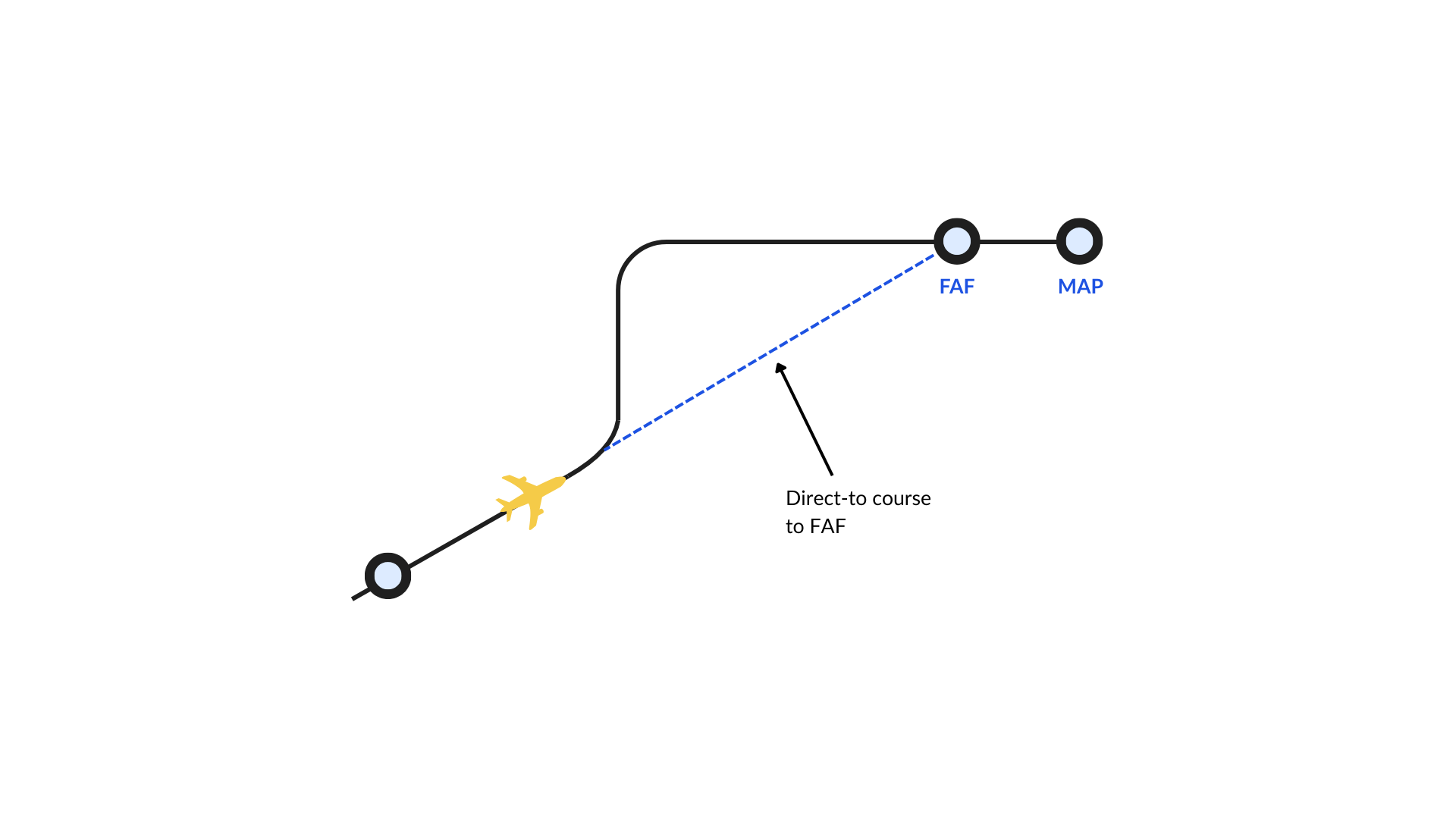
Another common path to a short approach is a simple early vector to final. Instead of letting the aircraft fly the full downwind, ATC clears the crew to intercept final directly or to proceed direct to the Final Approach Fix (FAF). This removes the base leg entirely, which can shorten the track by 2–6 NM depending on the airport.
It requires good anticipation. A direct-to clearance often comes while the aircraft is still at higher speed. If the pilot accepts it without preparing for deceleration, the aircraft may arrive at the intercept point too fast or too high. It involves to bring the speed back early, extend the flaps sooner, and use idle or reduced power to control energy.
This can also be called Tight circling or continuous turn-to-final.
Some airports or ATC patterns allow a continuous, curved turn to final. It resembles a circling-like maneuver but is executed as part of a normal arrival in VMC. The aircraft flies a tight, smooth arc toward the runway threshold, maintaining a constant bank angle and a stable descent rate. This avoids level-offs and removes unnecessary corners in the pattern.
| ℹ️ This technique is often used where terrain, noise constraints, or runway layout favor curved paths. It creates a naturally short approach because there is no rectangular pattern. The flight path is smooth and compact. |
Crews must manage configuration gradually during the turn, ensure the aircraft remains stable, and monitor drift carefully, especially in crosswind. When performed in good conditions, this is one of the most fuel-efficient ways to shorten an approach, because the path is both short and aerodynamically clean.
2. When and where to apply (or avoid) short approaches?
3. Benefits and Fuel Savings
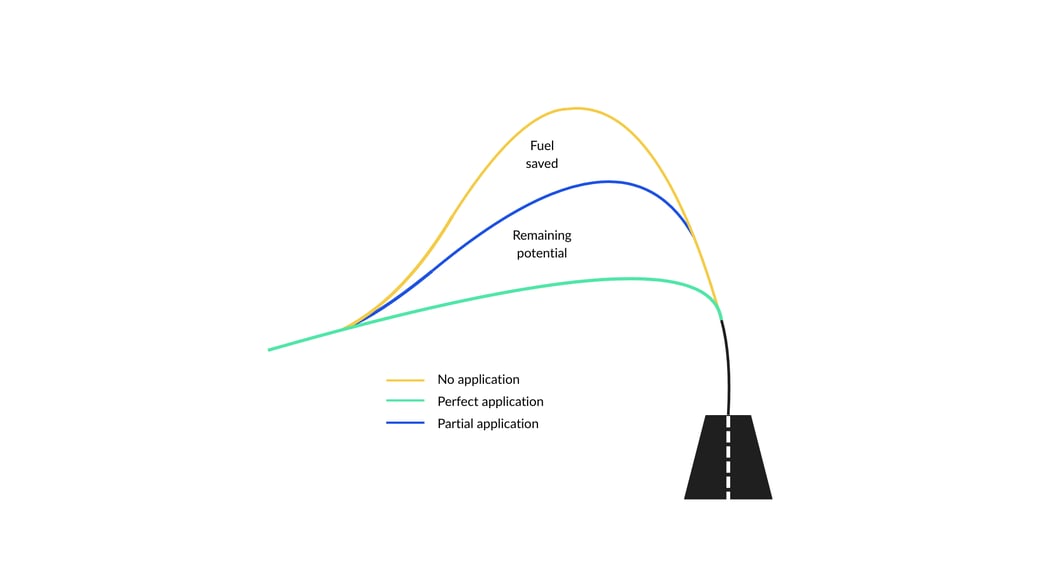
Some fuel analytics platforms, such as SkyBreathe®, can help us quantify the fuel-saving potential of a short approach by analysing thousands of trajectories and comparing the flown approach with historical patterns. These metrics rely on Flight Data Recorder (FDR) data and an AI-based classification of approaches. Associated fuel metrics are derived from historical trajectories, for a given set of criteria
Values depend heavily on airport geometry, ATC patterns, runway layout, and aircraft type.
Values depend heavily on airport geometry, ATC patterns, runway layout, and aircraft type. Based on the data of more than 15 million monitored flights and the SkyBreathe® Community airlines’ feedback, the following averages are commonly observed:
|
Average fuel saving: around 35 kg per short approach. Example: B738 at OSL saves approximately 30 kg per approach. |
Example of High-saving airports : KBP, MSQ, DEL, ISL, JFK, and PEK Often exceed 50 kg saved on average |
Time saved: Up to 2 minutes in the terminal area. |
Environmental impact: approximately 110 tons of CO₂ saved per 1,000 short approaches. |